Between Positional and Relational - Tilting
Analysing the main differences between Positional and Relational Tilting.
Introduction
Tilting is a concept in football where the players gather in close proximity around the ball carrier, this often takes place on the side of the pitch.
It can be combined with another concept (not always) called “Minimum Width” or “Optimal Width”, which is essentially a team lacking full width at any given vertical point on the pitch, when tilting that lack of width comes from the other side of the pitch.
Note: Minimum Width is a concept, it’s not linked directly to any idea, it is also used by some positional coaches like Sarri or Julian Nagelsmann for example.
Here is a great GIF from Jamie Scott (@JamiescottUV on Twitter) for the representation:
Often, relationist teams do this to get players in closer proximity to combine and to have more players in the center, with the main purpose of linking play from side to center through diagonal combinations.
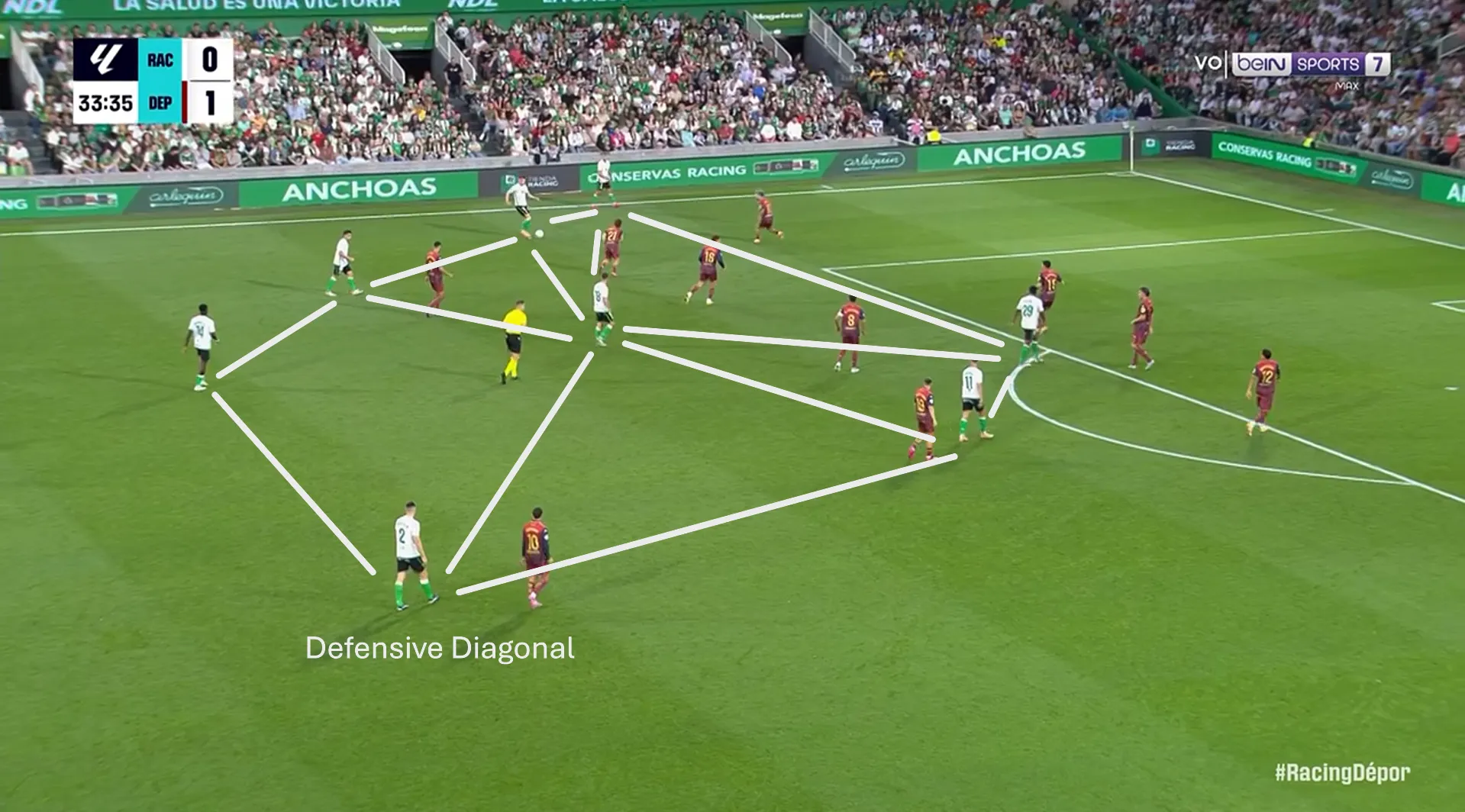
But some positional teams also do that tilting, normally without minimum width, because it is a core principle of positional play to maintain full width at any time, to stretch the opponent’s defensive line and sometimes even their midline . Recently, we saw some positional teams doing this, like Manchester City under Pep Guardiola, Como under Fabregas, and Leverkusen under Xabi Alonso, for example. To explain the main differences between the two approaches and what they try to achieve, we will use Xabi Alonso’s Leverkusen and Carlos Vicens’ SC Braga.
Time and Space
The main philosophical difference between Positional and Relational teams is the concept of Time vs. Space, as “József Bozsik” puts it in his Medium post:
É um ataque posicional porque espera que cada jogador domine o seu espaço para interagir depois. Cada jogador se encarrega de uma ação ofensiva que parte do espaço para o tempo, e cada elemento espera chegar a bola nele para desequilibrar.[2]
“It’s a positional attack because it expects each player to dominate their space before interacting. Each player is responsible for an offensive action that starts from space and moves towards timing, and each player waits for the ball to reach them to create imbalance.”
Assim, com definições espaciais e algum cuidado, o ataque funcional adaptado por Ancelotti parte do tempo para o espaço. É fundamental que cada jogador saiba exercer seu “personagem” em movimentação de campo, interpretando o dos outros. Os espaços são dominados depois do tempo com desmarques, superioridade numérica, movimentos, liberdade criativa, intuição, habilidade. Diz Ancelotti: “(…) en el fútbol los espacios se crean moviéndose y haciendo que los contrincantes se muevan. (…) La fase ofensiva se fundamenta en la colaboración y en la combinación de movimientos entre varios jugadores. Moverse continuamente en función del compañero que posee el balón da más posibilidades al desarrollo de la manobra”.[2]
“The functional attack adapted by Ancelotti starts from time to space. It is fundamental that each player knows how to exercise their “character” in field movement, interpreting that of others. Spaces are dominated after time with off-the-ball runs, numerical superiority, movement, creative freedom, intuition, and skill.”
Structure vs Ball Orientation
With this philosophical difference, some things become clear. To achieve that spatial dominance, positional teams often focus on structures and “positions”, which becomes part of that organization, what we normally call a “positional attack”. It’s a zonal form of attacking, positional teams organization is more structure-oriented:
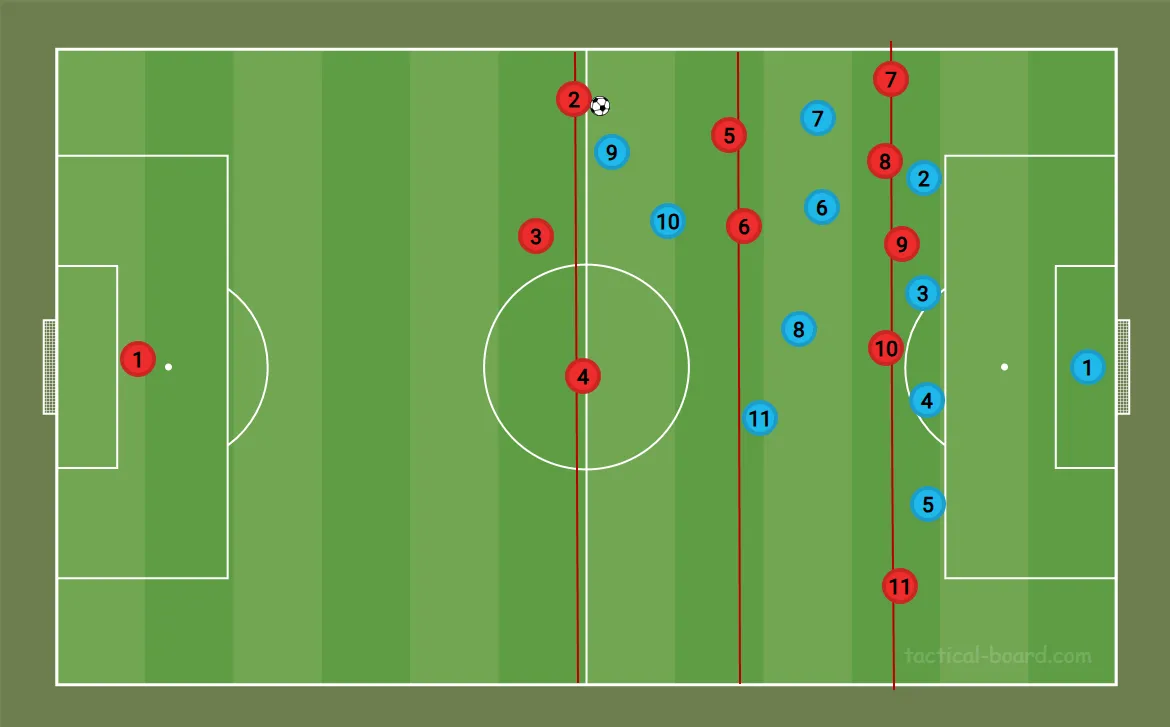
Players tilt but maintain their “positions” within the structure.
Relational teams try to achieve spatial dominance after they achieve time dominance through combinations and movements in space. That normally means that relational teams are more focused on the ball and on the ball carrier, so they are more ball-oriented:
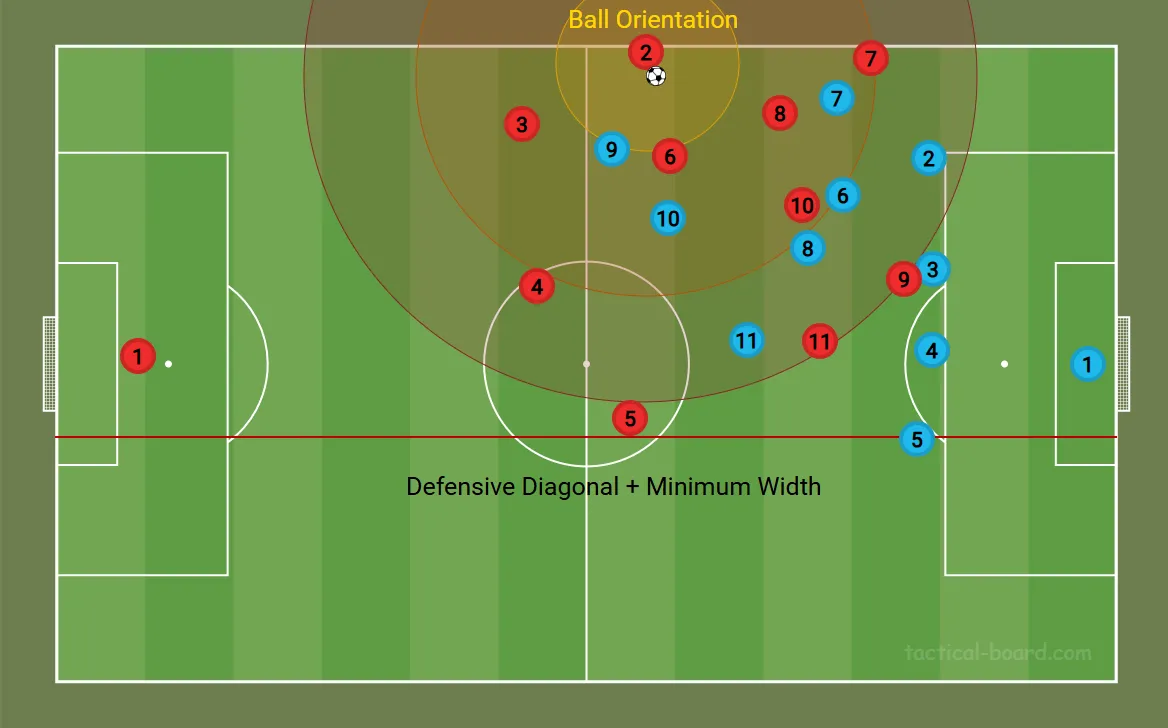
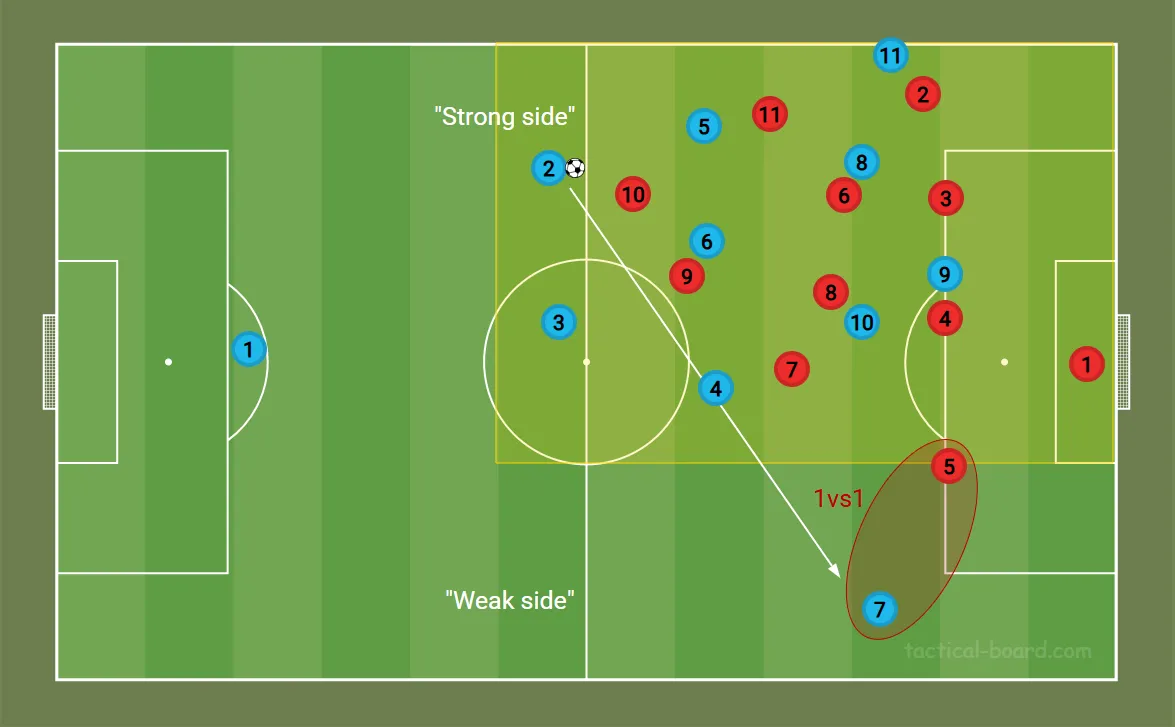
Another concept that shows this difference is the “Strong side - Weak Side”. Despite this concept being linked a lot to positional football nowdays, this concept was actually key to relational football in the past and it was different from what “Orthodox” Positional Play teams used to do because typically they used the “system” (structure) to attract teams to one side and then ended the play on the opposite side, through structure, often with simetrical positioning of players in the three channels of the pitch:
Aqui se cria também a ideia de “lado forte” e “lado fraco” da jogada. Cruyff, na lógica do jogo de posição, dizia que uma equipe deveria atacar por um lado e definir pelo outro. Isto era feito simetricamente dentro do sistema, podendo ir da esquerda para direita ou da direita para esquerda.[1]
“Cruyff, in the logic of positional play, said that a team should attack down one side and finish from the other. This was done symmetrically within the system, possibly going from left to right or from right to left.”
Cruyff falava que um ataque deveria começar por um lado e terminar por outro, mas isto era feito de maneira posicional. Ou seja, se começava fazendo o jogo de posição entre zagueiro-direito, ponta-direita, meia-direita, meia-atacante no 343, pode terminar virando a bola para o ponta-esquerda driblar e tocar para o centroavante fazer o gol. A virada de um lado para o outro é feita dentro da lógica de posições.[2]
“Cruyff said that an attack should start on one side and end on the other, but this was done positionally. That is, if it started with positional play between the right-back, right winger, right midfielder, and attacking midfielder in a 3-4-3 formation, it could end with the ball being switched to the left winger to dribble and pass to the center forward to score. The switch from one side to the other is done within the logic of positions.”
But, in relational football, the idea was to actually create a “strong side” by gathering more players on that side to gain numerical superiority and achieve a more vertical game with short and creative passes, along with supporting runs and movements to receive the ball in space.
No ataque funcional do Brasil, havia uma estratégia anti-posicional. Você coloca mais jogadores de um lado do campo, o “lado forte”, que será sempre aquele, ganha superioridade numérica por ali, produzindo um jogo vertical, de toques curtos e criativos, apoiado em torno dos desmarques dos jogadores para receberem a bola. Interagir e controlar o tempo para dominar o espaço.[1]
“By placing more players on one side of the field, the “strong side,” which will always be that side, you gain numerical superiority there, producing a vertical game of short, creative passes, based on players making runs to receive the ball. Interacting and controlling Time to dominate Space.”
No ataque funcional, a lógica é anti-posicional. Você coloca mais jogadores de um lado do campo e ali será o “lado forte” do seu ataque, com superioridade numérica e muita gente para tocar a bola. E o “lado fraco” será o outro para definir a jogada.[2]
“You put more players on one side of the field, and that will be the “strong side” of your attack, with numerical superiority and plenty of players to pass the ball to. And the “weak side” will be the other side, where you’ll finish the play.”
Positional Attack With Tilting
But today we see a lot more positional teams tilting to one side too, still focusing on structure but the structure tilts to one side. But why? I see two main advantages for that, one is that teams can use this to attract the opposition to one side of the pitch, by achieving numerical superiority and isolating one player on the other side for a 1v1, the qualitative superiority that is key in these situations in Positional Play. (Guardiola used this a lot in the 2017/18 season)
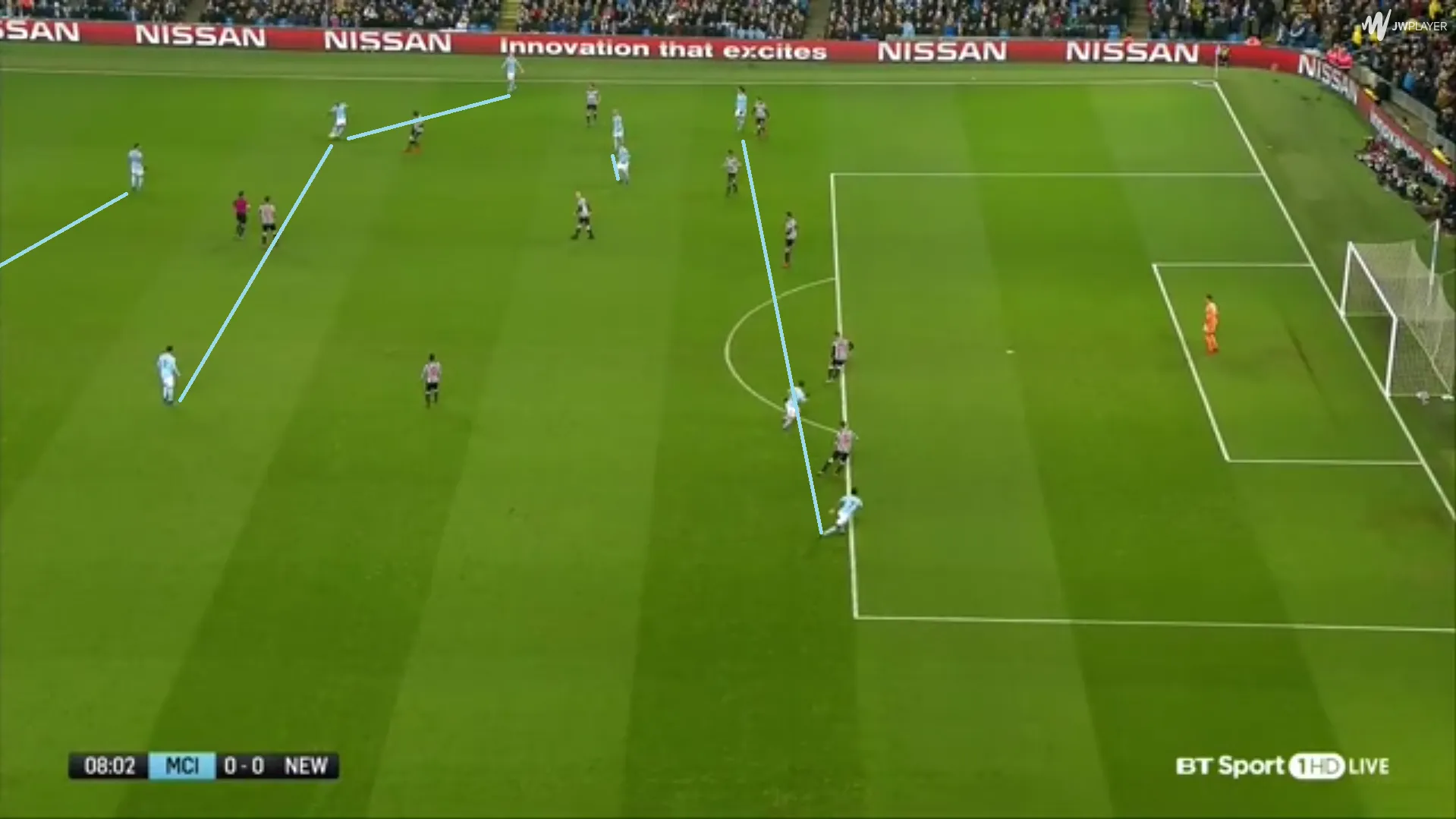
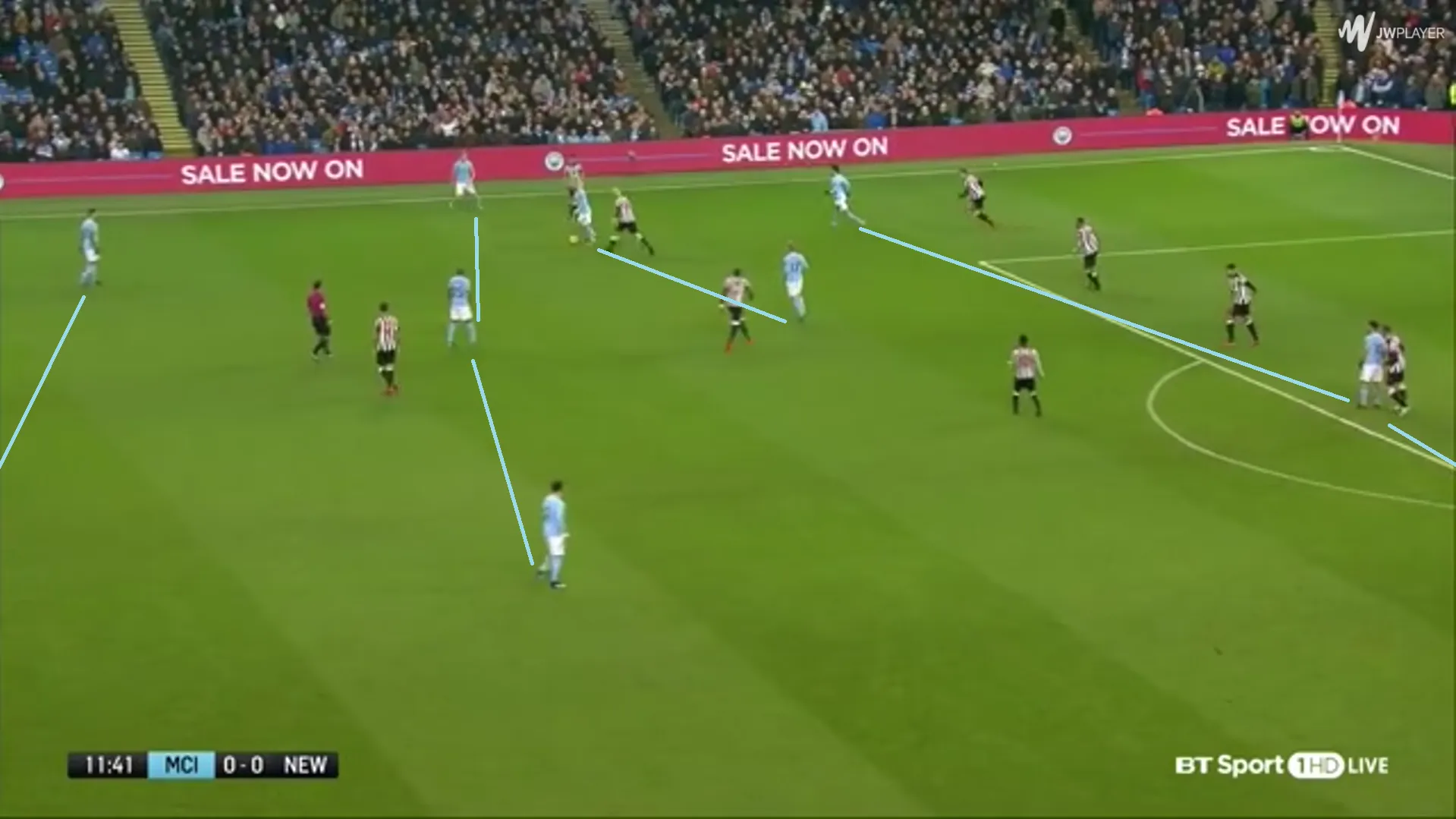
This is nothing new and also this season (2025/26) we saw Pep’s Manchester City tilting a lot more than usual in some games, also using a different structure from the “default” 3-1-5-1 with wide wingers that we mainly saw last season (and that was still very much the main offensive structure this season as well), using both wingers inside instead to help accommodate Cherki and Foden and letting the fullbacks give width on the flanks but in deeper positions than the usual wingers, making a more traditional 4-2-3-1 initial shape with a lot of rotations, but we might go a bit deeper on that in a future post.
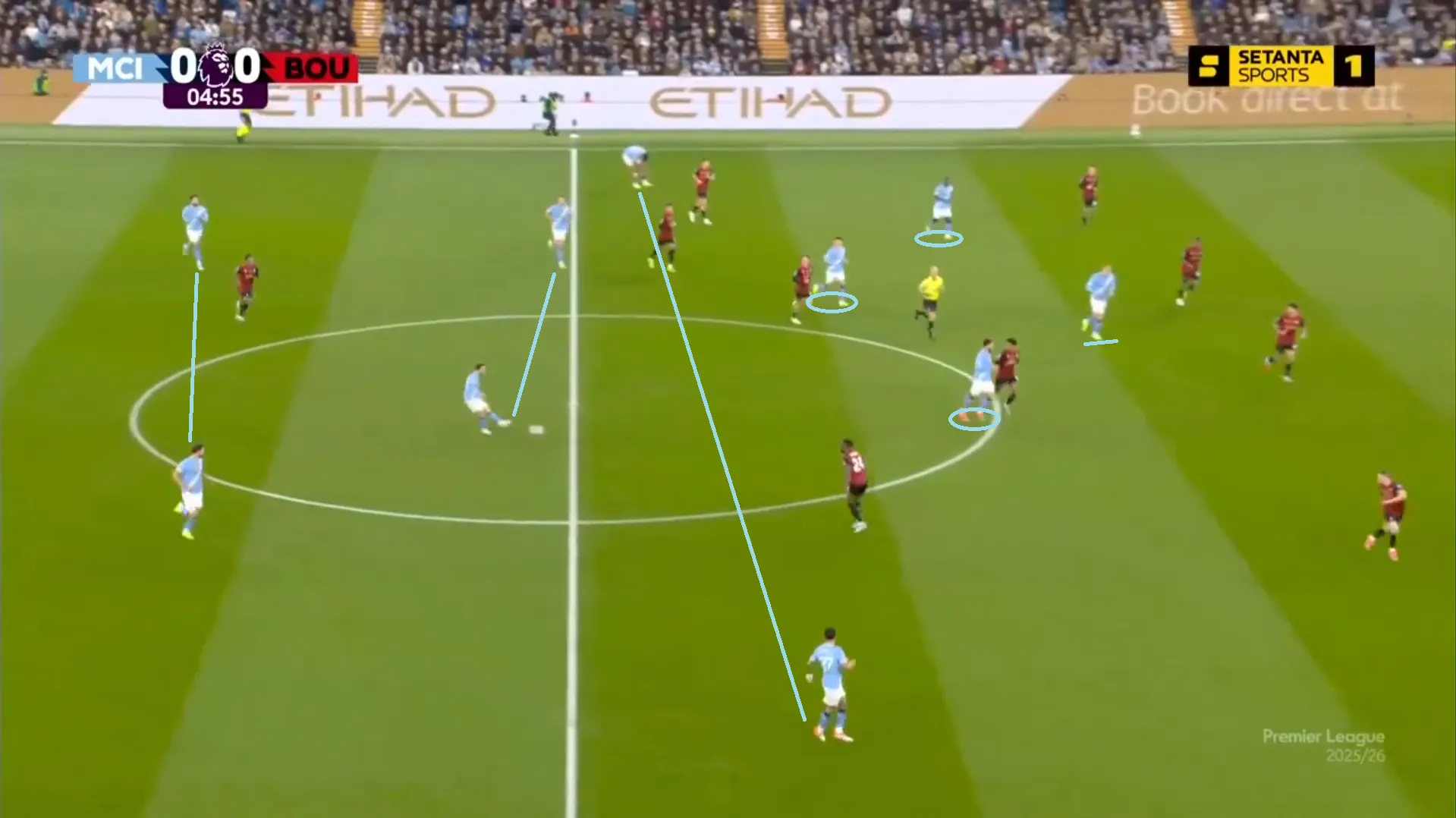
Note: The players in circles are the free roaming middle three, Foden, Cherki and Doku, the “floaters”.
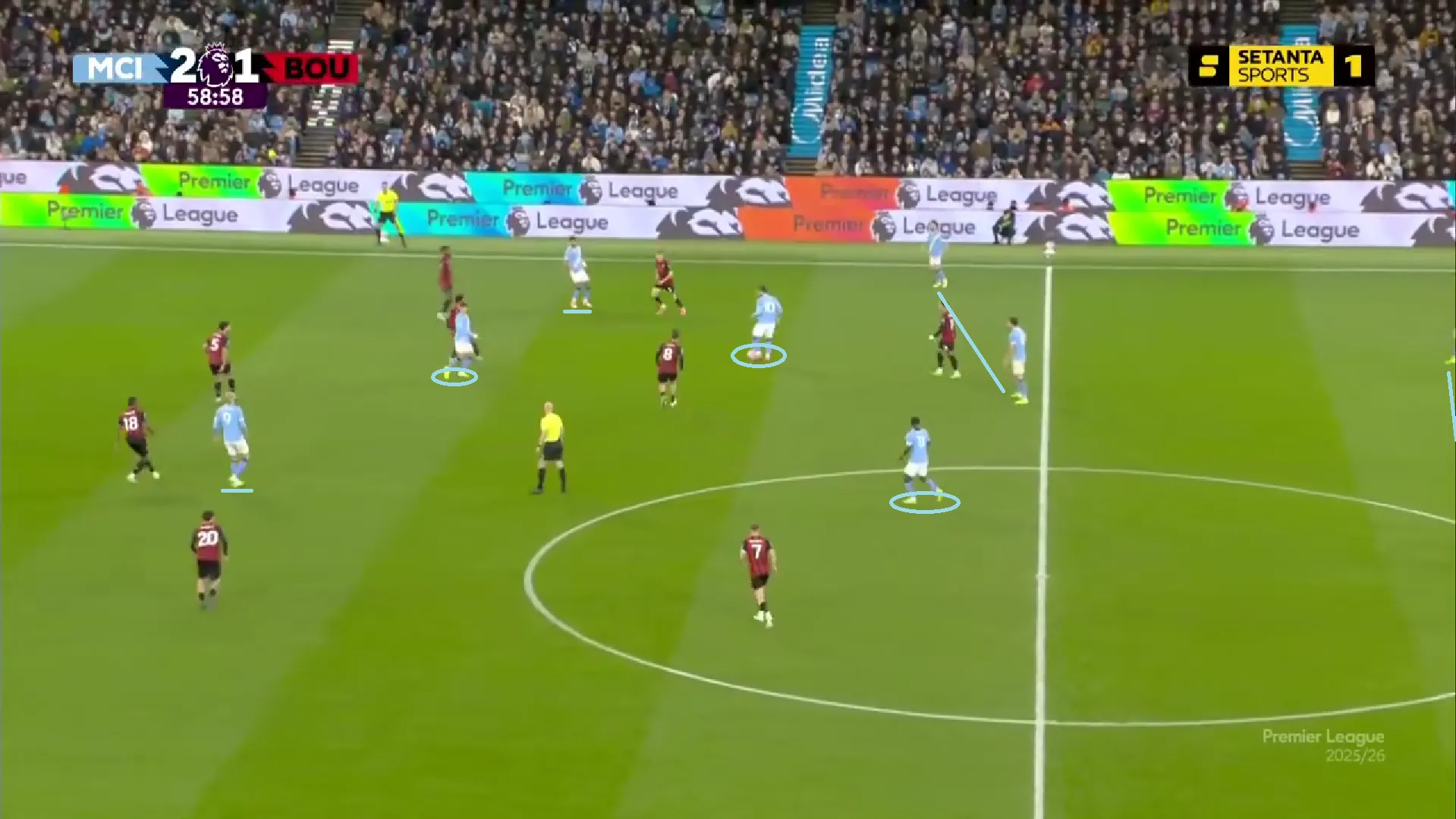
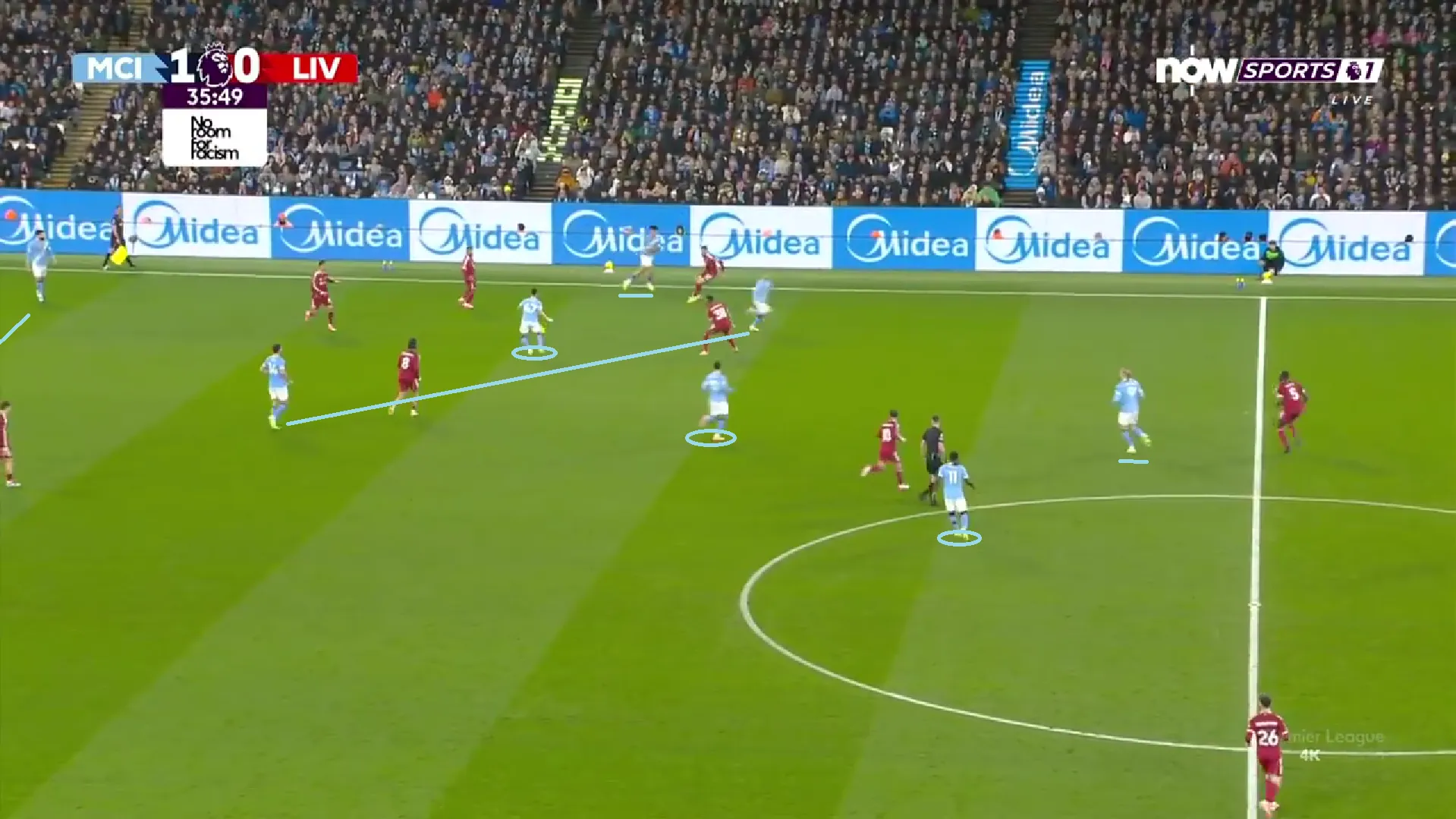
The other advantage that became very important in modern football is the counter-press. It is easier to counter press when players are closer to each other and nearer to the ball. There are a lot of types of counter press (man oriented, zone/space oriented, passing lane oriented and ball oriented) but all of them are easier and more efficient if players are closer.
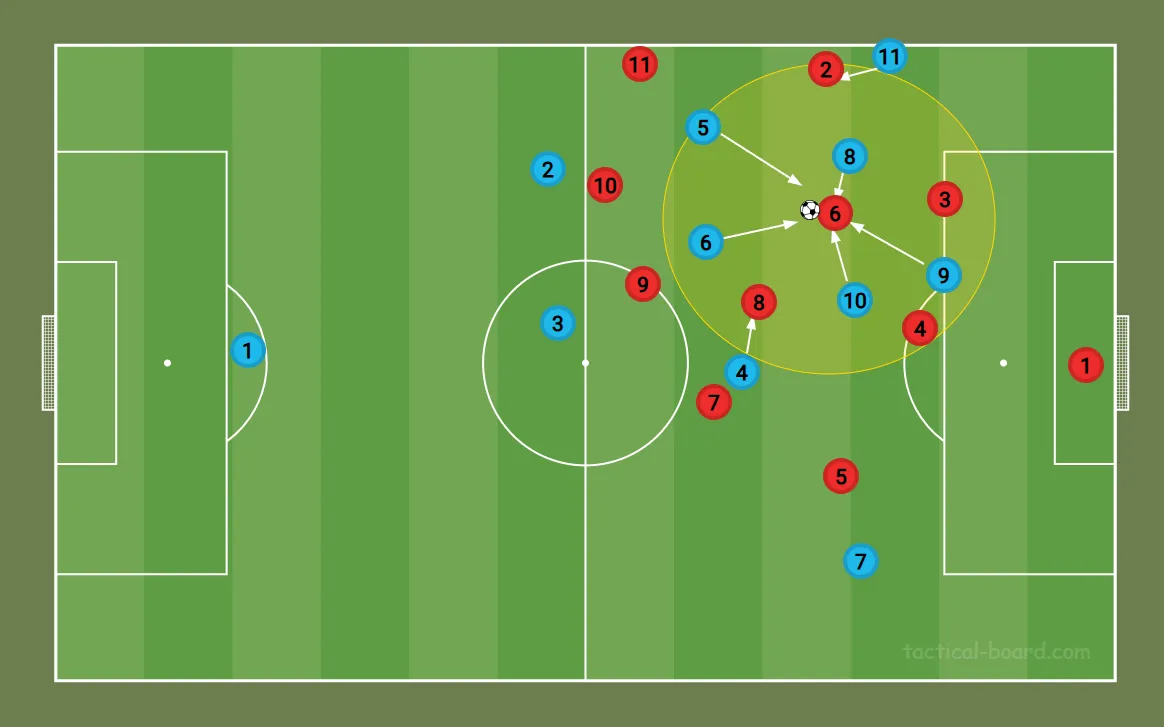
And recently, as said before, a lot of positional teams started to play much more on the Strong side, achieving a more vertical play and focusing a bit less on using the weaker side. A big example is Leverkusen under Xabi Alonso, utilizing a 3-2-5 structure with the two offensive midfielders (often Wirtz and Hoffmann) in “free roles”, that would tilt much more than others towards the ball side and were a lot more positionally free to combine and move around, and sometimes even playing on the same side at the same time, compared to the rest of the team, wich, even when tilting maintained structure.
Another similar example this season was SC Braga under Carlos Vicens. Vicens was part of Pep Guardiola staff in the past, so his positional ideas are very noticeable, but just like Xabi he also gave Braga a different look, with a 3-2-5, using Pau Vitor as some sort of “False 9”, dropping deep to help combine and link play and Ricardo Horta and Zalazar has those two free offensive midfielders. When Braga tilted we also saw them playing closer to the ball but just like Leverkusen, the team maintained structure even when tilting.
But notice how these teams even with players playing closer maintain the focus on core Positional Play concepts and principles, often:
-
Attracting pressure to beat it and switch;
-
Using structure, positional advantages and space to achieve the third man;
-
Using more patterned movements and combinations to find a free man;
-
Using frontal support to get the free man between the lines facing the goal;
-
Player movements and position rotations are coordinated to maintain structure and balance.
Funcional/Relational Attack
The Portuguese term “Ataque Funcional” or Functional Attack in English, comes from the word “Função” wich translates to Role. In this context the “Player Role”, so in a Relational Attack the main focus is the natural relations between players and the combination of their roles. For this, relational teams normally use shorter distances between players closer to the ball, usually create clusters of 3, 4, 5, or more players in the ball zone to make combinations easier.
O time não se organiza primeiro através dos espaços, mas através do movimento da bola. Isto permite mais jogadores no setor da bola, mais liberdade posicional e interpretação adequada, e o movimento adequado para que os espaços não sejam perdidos.[3]
“The team doesn’t organize itself primarily through space, but through the movement of the ball. This allows for more players in the area of the ball, more positional freedom and proper interpretation, and the appropriate movement so that spaces are not lost.”
O que o jogo funcional exige? A) Dinâmica corporal. Movimentar-se bastante de acordo com a bola; B) Interpretação do que fazer e de como fazer. Vou abrir, vou passar e receber na frente, vou vir aqui atrás armar, vou para aquele espaço vazio porque alguém abandonou sua posição?; C) Independência, autonomia, impetuosidade para ser agressivo. Responsabilidade intuitiva para “abandonar” lugar sem embolar o jogo.
“What does functional play require? A) Body dynamics. Moving a lot according to the ball; B) Interpretation of what to do and how to do it. Should I open up, should I pass and receive in front, should I come back here to set up play, should I go to that empty space because someone abandoned their position?; C) Independence, autonomy, impetuosity to be aggressive. Intuitive responsibility to “abandon” a position without disrupting the game.”
Note: Relational teams also have positions and even structure or shape sometimes, but positions are more an initial reference or a reference to maintain balance during attack.
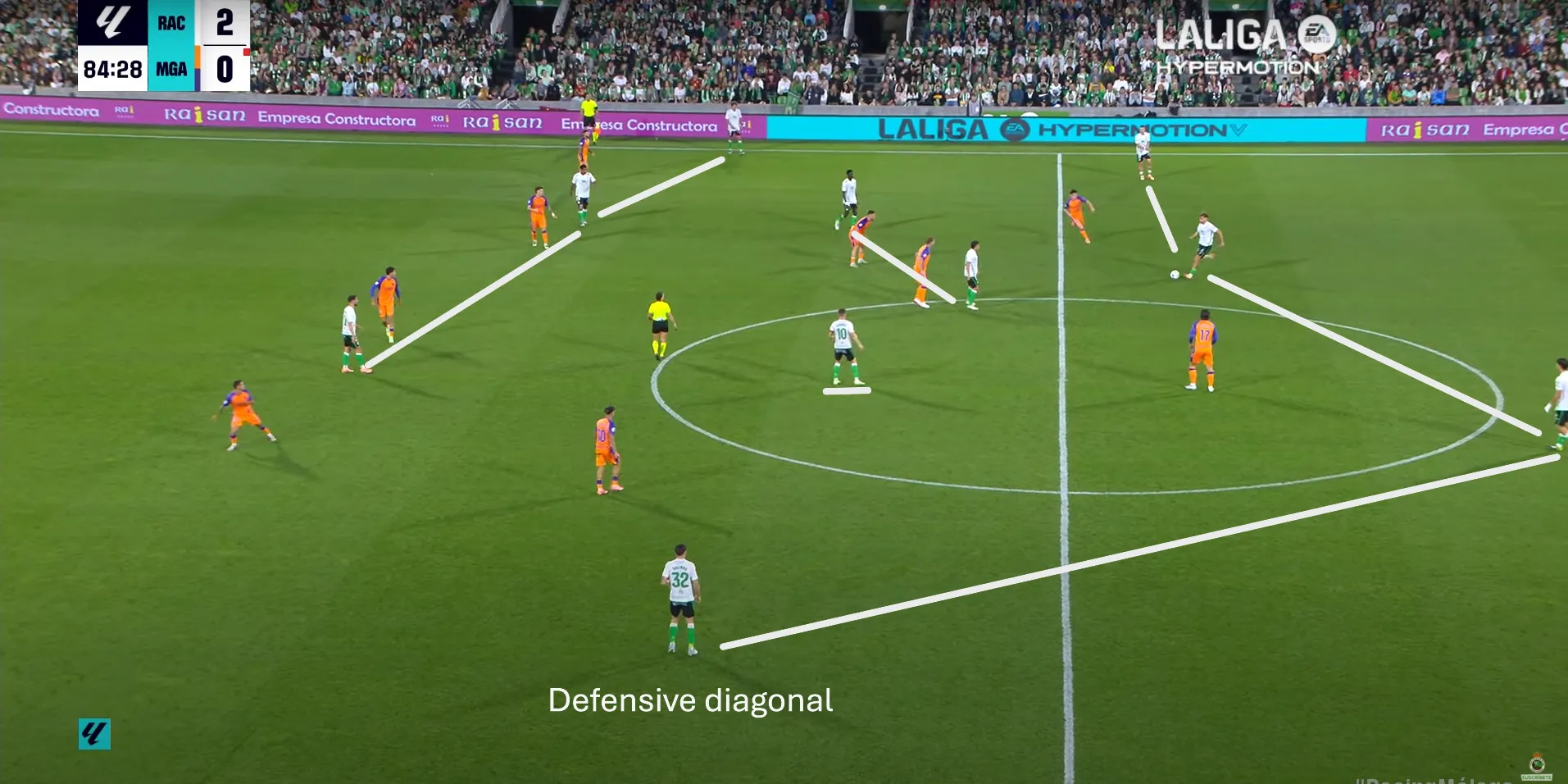
Relational teams also use width but in a different way, their goal is not to gain structural or positional advantages but to get a player attacking space with time, to achieve dynamic superiority, many times even coming from a deeper position, from a defensive diagonal position for example, so full width at all times might not be necessary and teams might even force the play through the Strong side with vertical combinations instead of switching the play, they might even fake the switch and remain on that side (the yo-yo).
These clusters near the ball are normally used to achieve numerical superiority in the ball zone and they don’t really have fixed positions, players are free to move and find space to combine and relate better to other players around them, they don’t rely on structure or positions as much to maintain balance, instead they use intuition to balance their movements and also, having that numerical superiority near the ball zone also makes it easier to conter-press when you lose the ball. Here is important to make reference to the “Defensive Diagonal” again, which consists of having a player, normally the opposite side fullback, with a deeper and more conservative position than their teammates - sometimes even forming a back three with the two center backs (in a back four) - to balance the team shape and help defend the center of the pitch if the opponent gains possession, but also that deeper position can be deadly if the team looks for the weak side, that fullback could have a lot of time and space to attack.
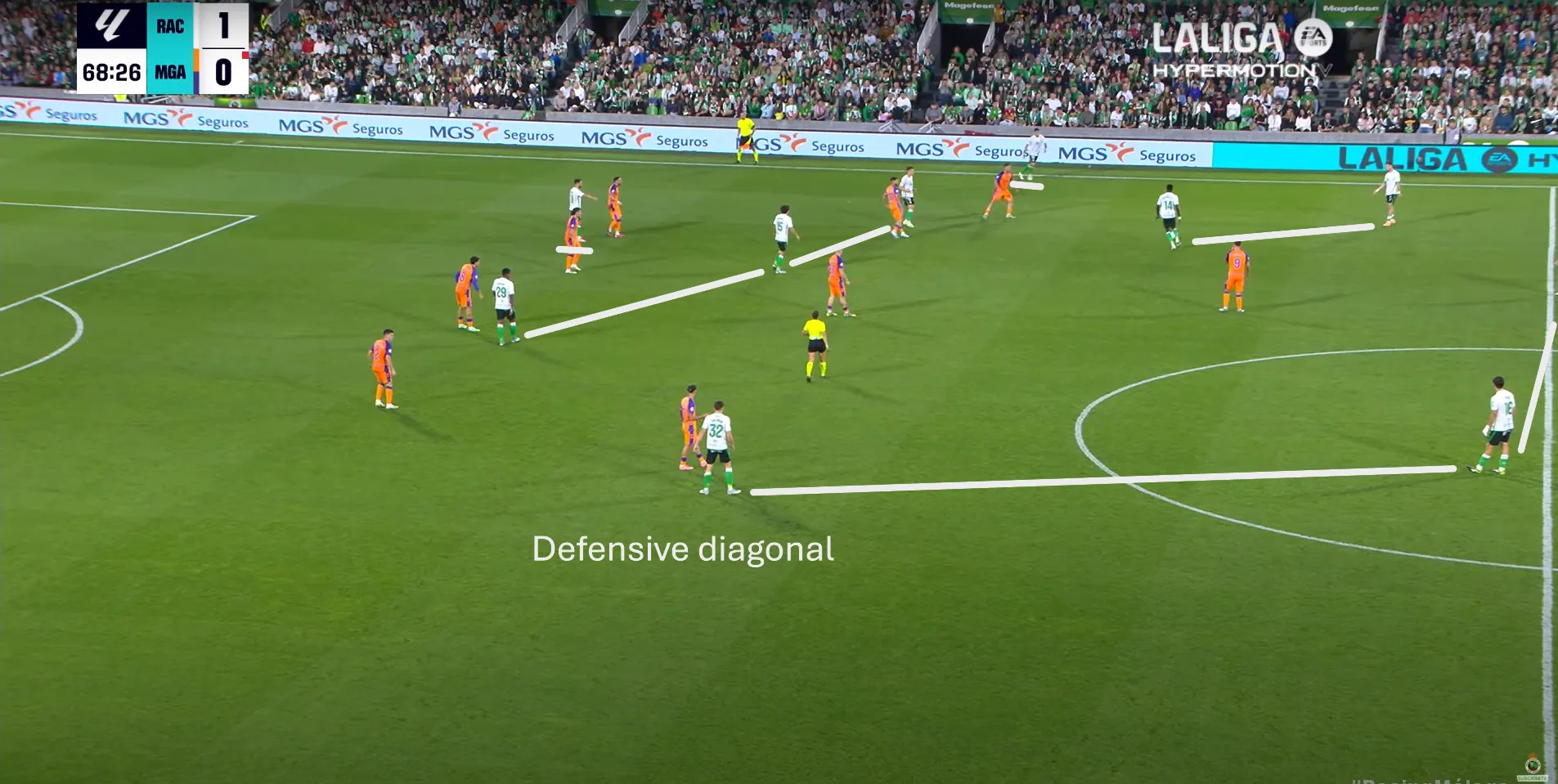
In Relational attacks, the main focus is the dynamic superiority and its goal is to gain a dynamic advantage against your marker or against the defensive structure around you. To achieve this, teams focus on movement and player freedom and naturally the one-twos (tabela), the pass and move (toco y me voy) and dummy movements (corta-luz) are key for this style of play, with players moving and combining dynamically in space.
With this comes the concept of Diagonality, where players use micro-structures, sometimes lines or Z shaped patterns with three or four players, these are called “Escadinhas” or staircases (stairs for short) in English. They can be vertical but also diagonal and are key to facilitating combinations by using 360 degree perception among the players and especially in diagonals because players have a more open body orientation to face a teammate or to attack space easily.
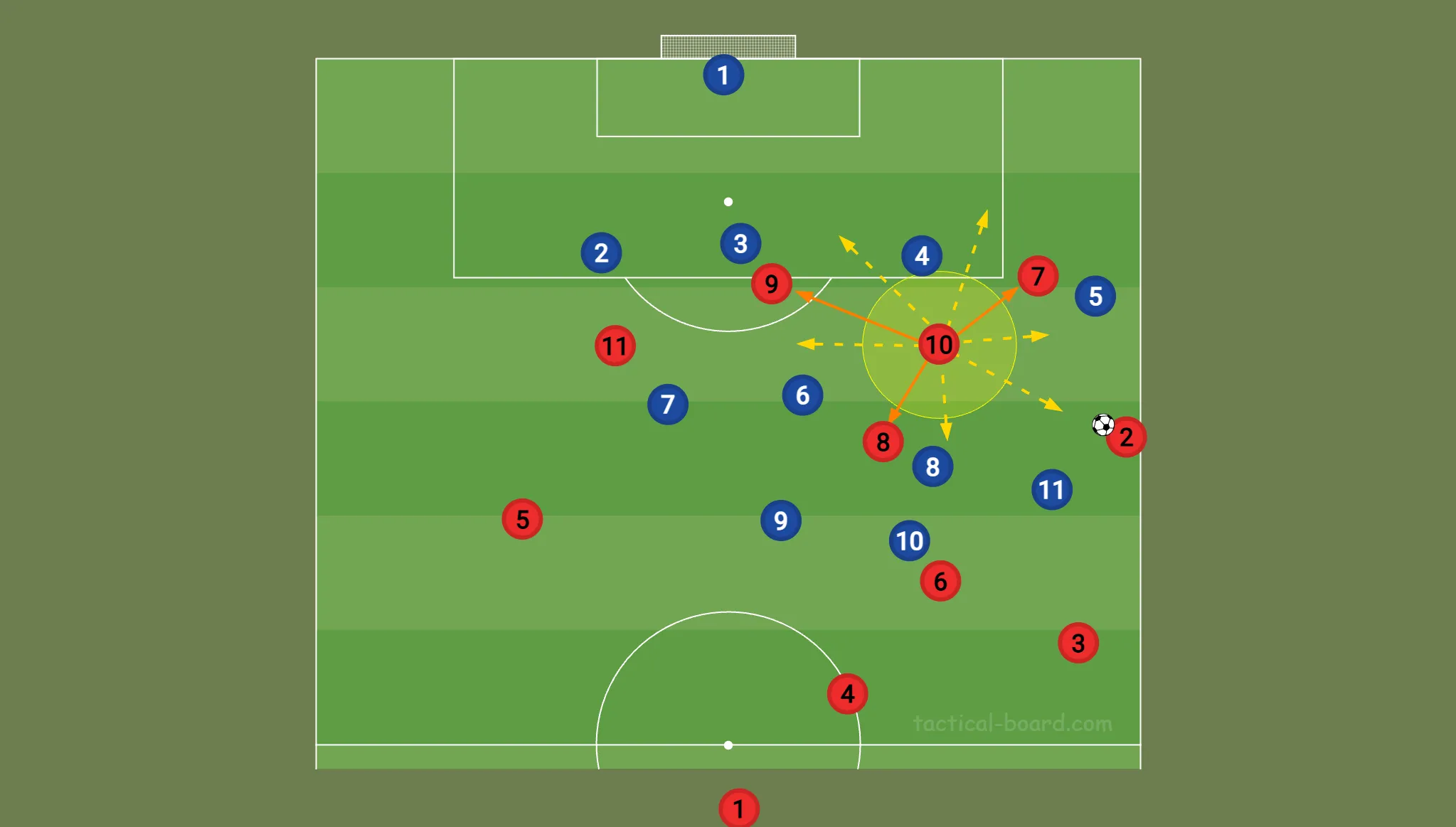
Those diagonal lines appear around the ball carrier and can be formed naturally by player movement around space or formed through player communication and perception around space.
The diagonal pass from the outside does more than just deliver the ball into the striker’s feet. It delivers a nexus of vectors. It is the passage of a line of flight into a zone of maximal variance. Why? Because geometrically and tactically, this is the highest density of playable options the game of football allows.[4]
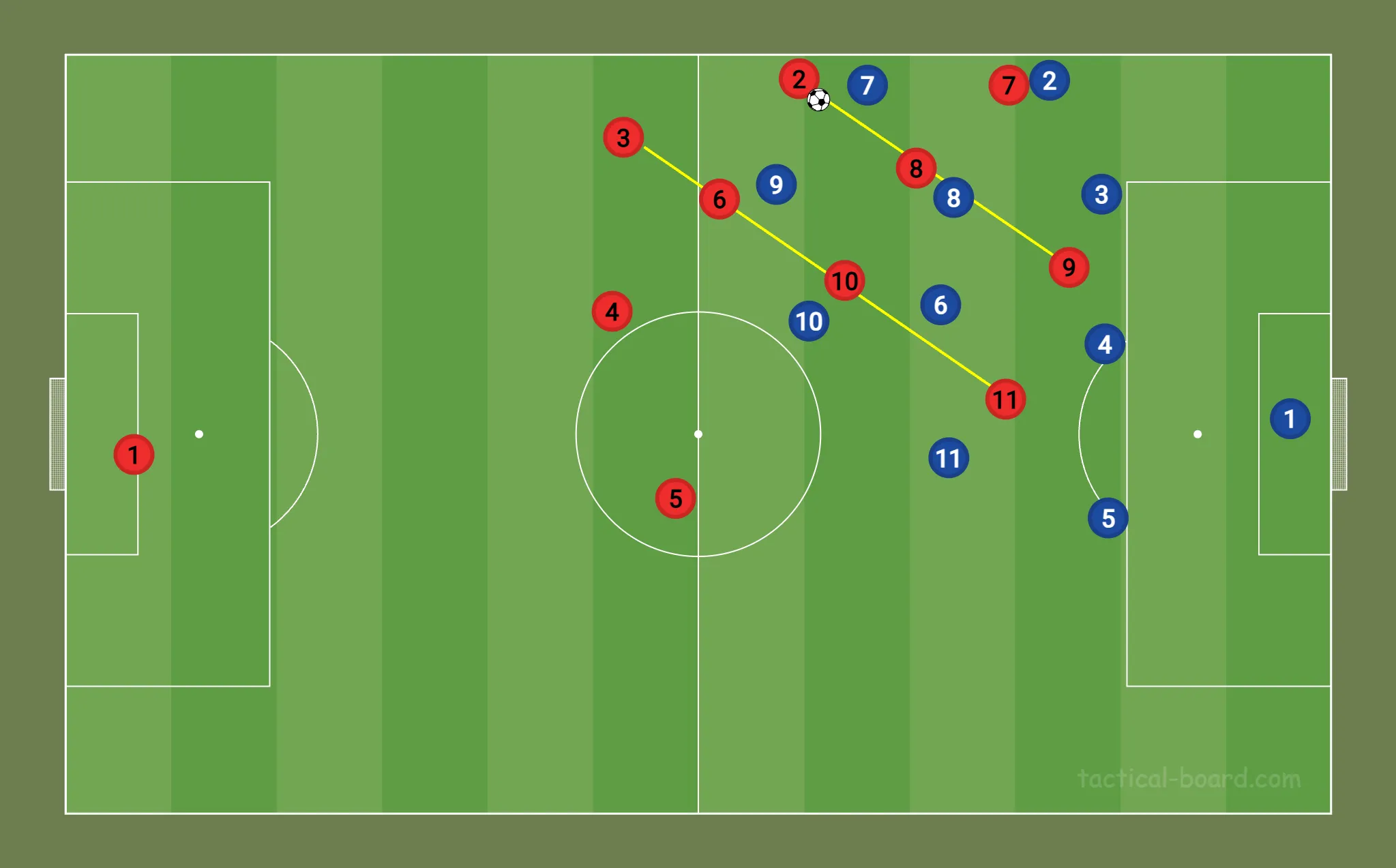
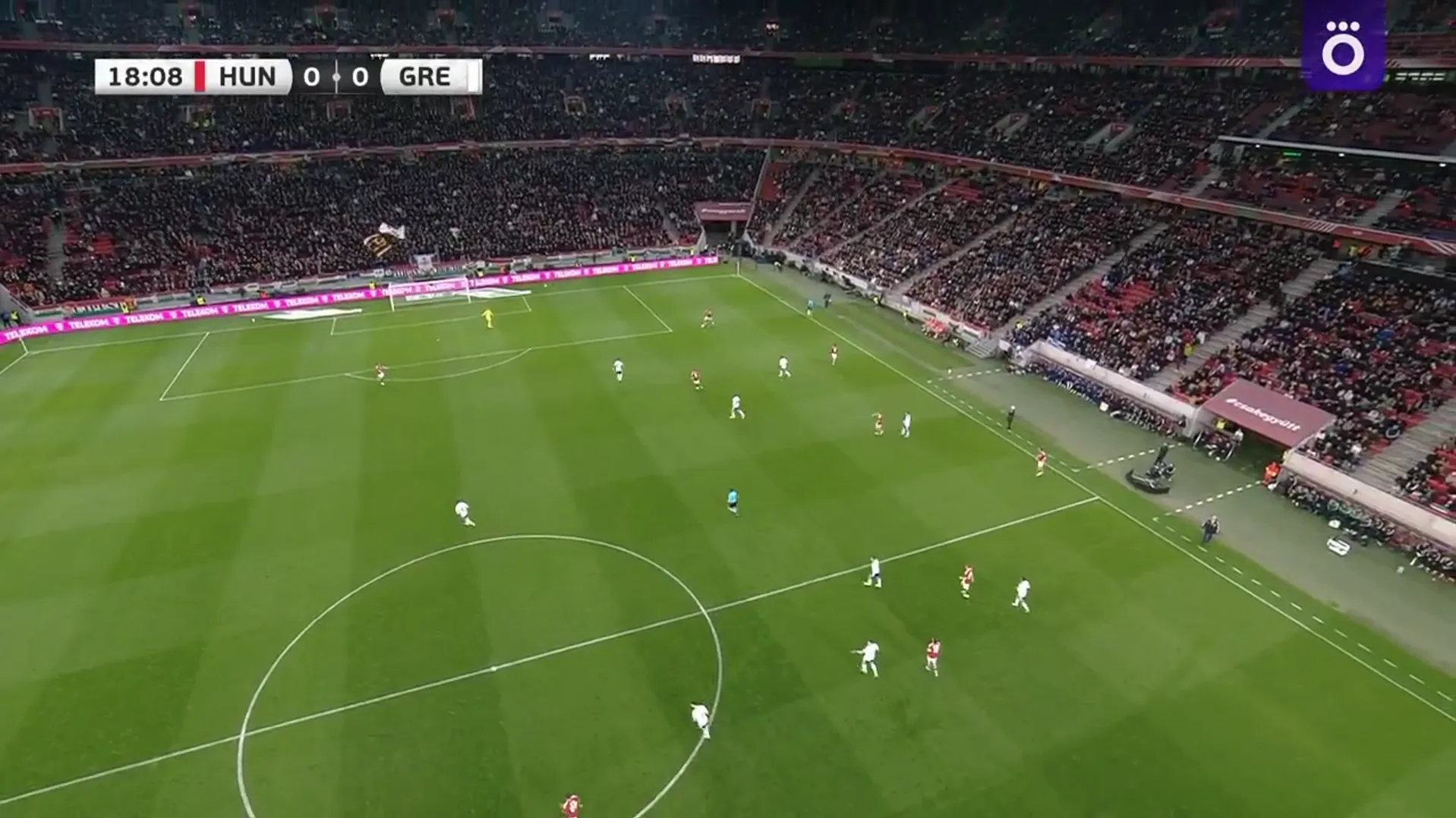
A great example of a Relational National team that has used tilting a lot in the past few years is Hungary, returning to its Relational roots from the past under Marco Rossi, has the Italian coach said:
We are playing a kind of football that is less positional and more relational, and Dominik [Szoboszlai] is a player, together with others, who is free to go where he feels he can go… and this gives him more responsibility…
If you want to dive a bit deeper into some Relationist concepts that Relationist teams use, you can check my other post where I used Arsène Wenger’s Arsenal to demonstrate some Relationist basics:
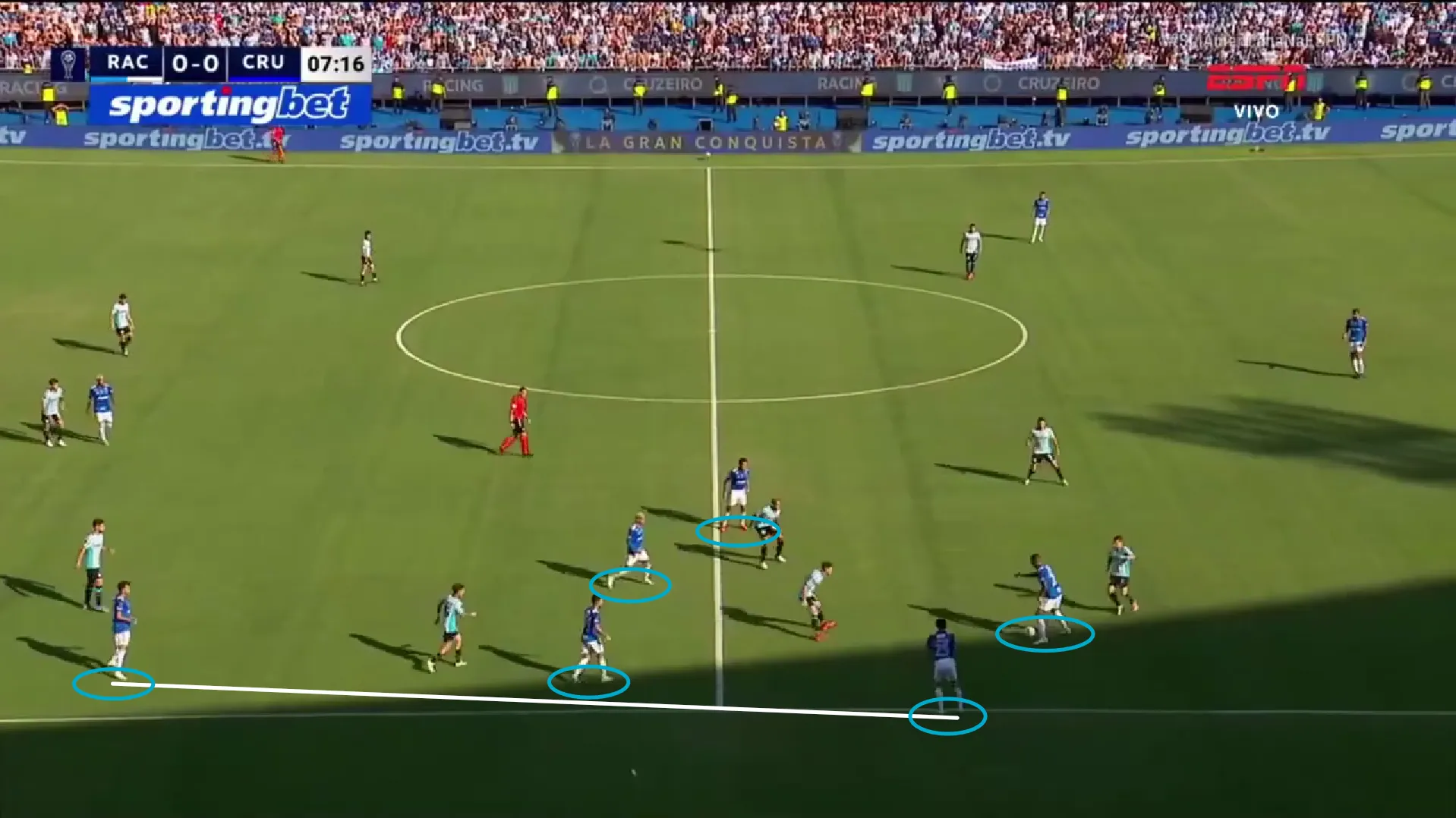
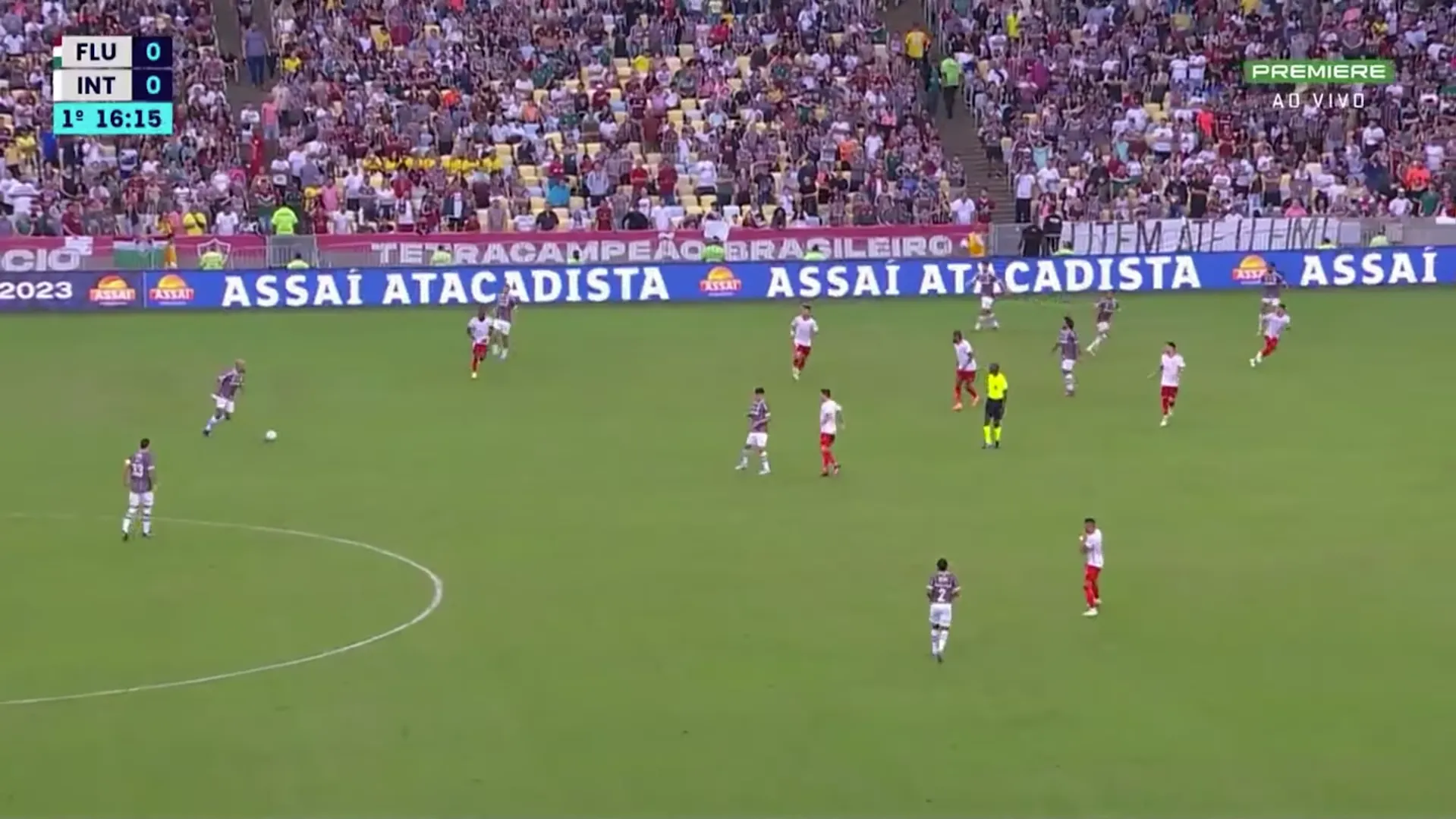
Finally, the “Paralela Cheia” is a term that is being used a lot in the mainstream tactical space now and the coach who is responsible for that is Fernando Diniz. The Paralela Cheia is basically a hard tilt that is formed on one side of the pitch, where 2 or 3 players form a line near the sideline of the pitch (double or even triple width) and the other players gather around them to combine and facilitate play, sometimes you even see the 2 wingers on the same side of the pitch, with the 10 and also the two center midfielders close, basically creating a giant rondo but without fixed positions, where players are free to move and combine.
The “Hybrid” Approach
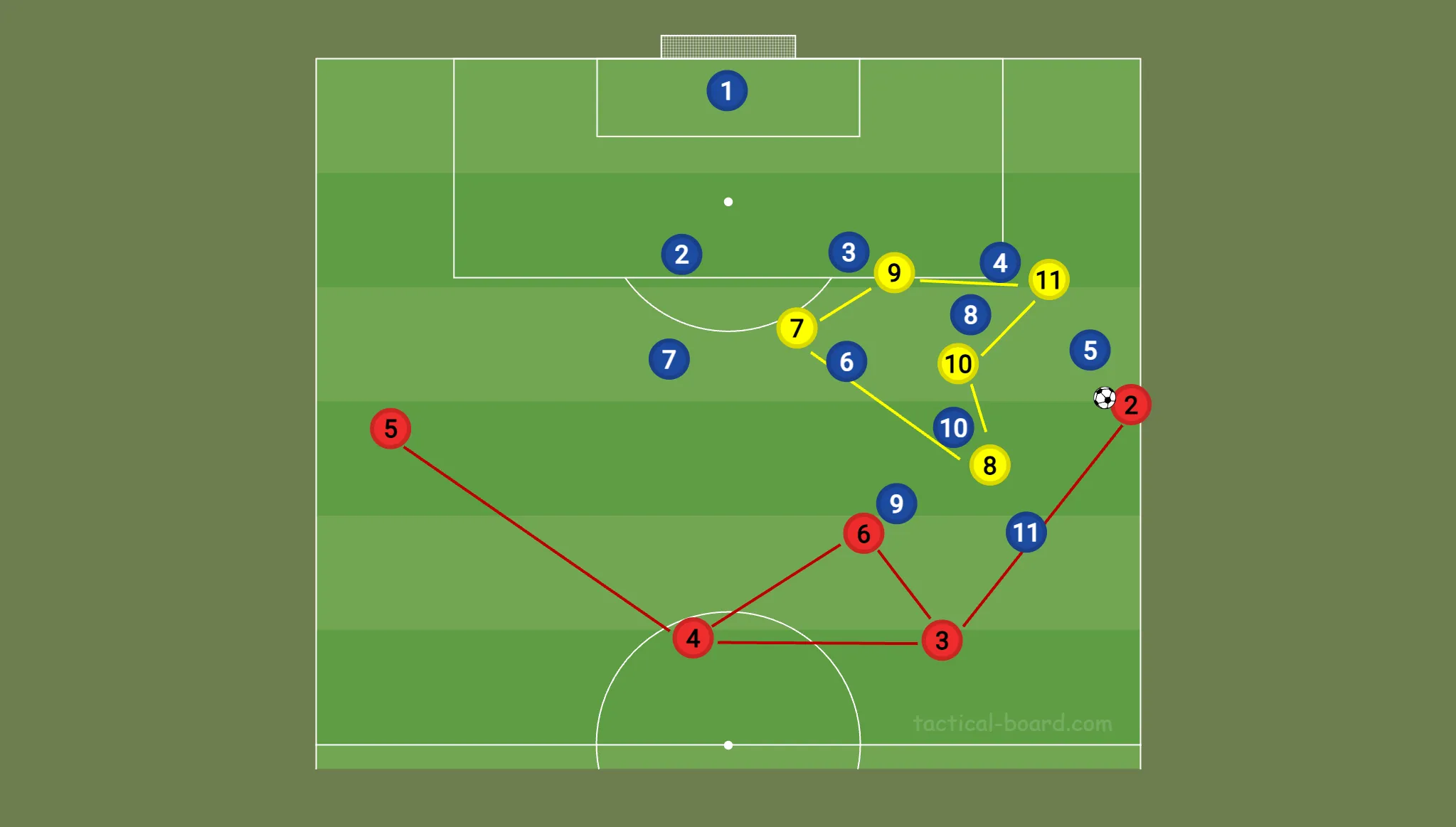
A concept that is being used by Relational and even Positional teams to great effect to help with this is the “Anchor and Floaters” concept which basically means there will be some players with a more balanced positioning around the tilt, the “anchors”, and some others that will roam and have free roles, “the floaters”.
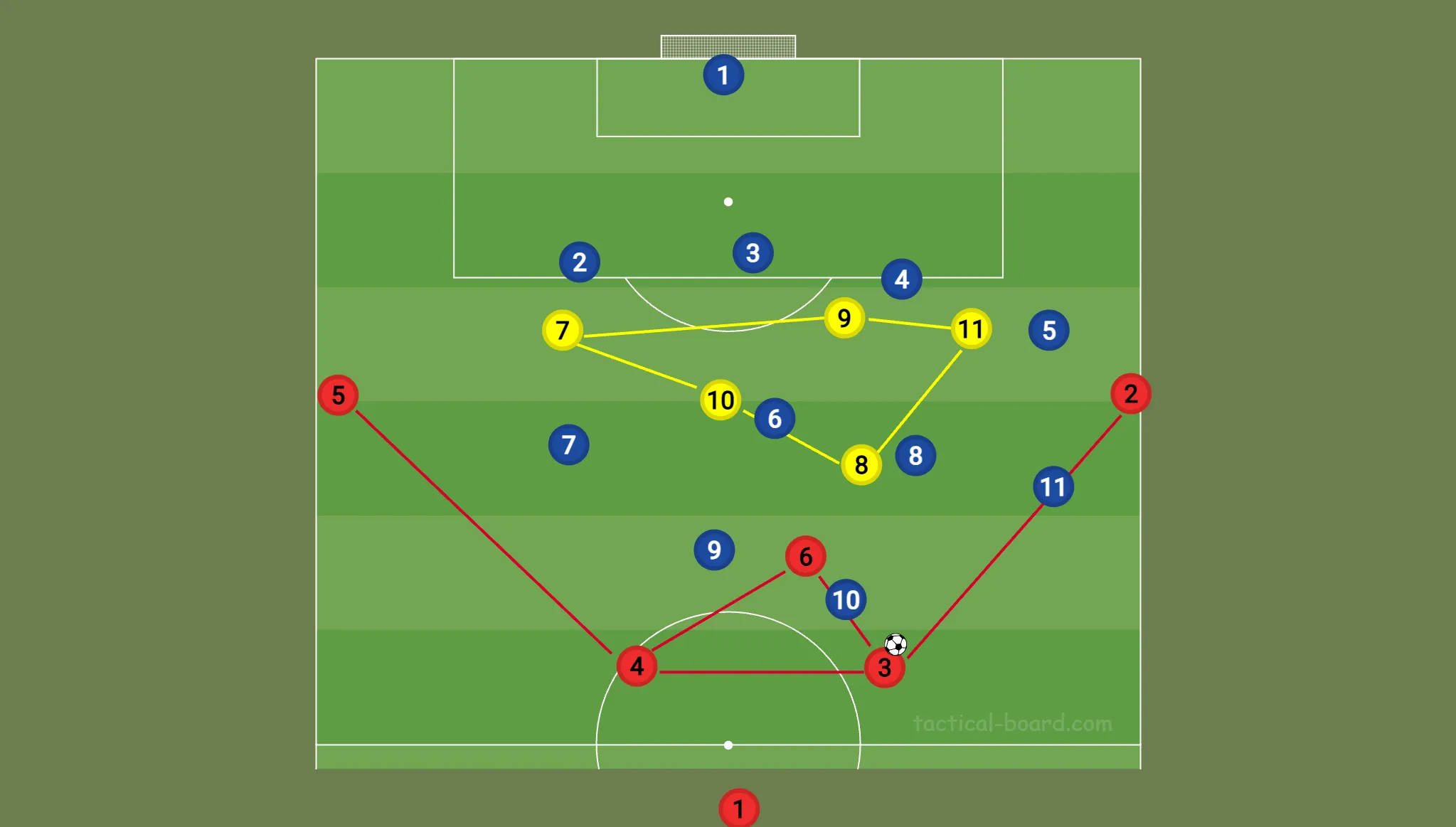
Note: The anchors are represented as the red dots and the floaters as the yellow dots.
So naturally, when the tilt happens, the anchors often maintain a similar position to what they had when the ball was at the center, but the floaters are often more ball oriented and also tend to tilt toward the ball position, the difference from a positional tilt is that the floaters have a lot more freedom, often even ignoring structure, unlike the more orthodox positional tilts.
Important Note: The reason I call this approach “hybrid” is that the Anchors and Floaters concept is not directly linked to a Positional or to a Relational idea, it is a concept not an idea, and it is probably most used by Relational teams naturally, but we saw in the past (Barcelona under Guardiola for example) and are seeing today again many Positional teams adopting this, and as we saw from Leverkusen and Braga, the two offensive midfielders could be considered floaters in those systems as well.
We can also put that Man City 4-2-3-1 from this season we talked about before as an example, with Foden, Cherki and Doku being the floaters.
Here are some very interesting posts about this concept:
There are also other “hybrid” concepts that teams use but we will take a look on that in the future, that is not the focus of this post but is important to also note that.
Final Thoughts
As Jamie Hamilton recently said on twitter:
Highlighting that players are grouped together doesn’t tell us anything particularly interesting. It is the intentions that have led to the proximity, and the behaviours/interactions that emerge from it, that inform us about a team’s style and language of play.
Positional play can be played with players closer together and Relational play can also be played with players at larger distances between them, distance and “positions” have nothing to do with it. If you really want to understand these ideas you have to look closer and fully understand the intentions and behaviors behind them.
It is normal that Positional teams use some more “relational concepts” and vice versa. The biggest thing we as analysts have to look at is the intentions of players, coaches and ideas to understand what they are really trying to achieve with those concepts.
Sources
[1] - Entre a bola e o homem há o espaço e o tempo: ataque posicional, jogo de posição e ataque funcional (parte I) - https://medium.com/@Jozsef_Bozsik/entre-a-bola-e-o-homem-h%C3%A1-o-espa%C3%A7o-e-o-tempo-ataque-posicional-jogo-de-posi%C3%A7%C3%A3o-e-ataque-89fd98088355
[2] - Entre a bola e o homem há o espaço e o tempo: ataque posicional, jogo de posição e ataque funcional (parte II) - https://medium.com/@Jozsef_Bozsik/entre-a-bola-e-o-homem-h%C3%A1-o-espa%C3%A7o-e-o-tempo-ataque-posicional-jogo-de-posi%C3%A7%C3%A3o-e-ataque-funcional-6c70bc622931
[3] - A bola, o indivíduo e o espaço: defesa por zona e individual, ataque por zona (posicional) e “não-zona” (funcional) - https://medium.com/@Jozsef_Bozsik/a-bola-o-indiv%C3%ADduo-e-o-espa%C3%A7o-defesa-por-zona-e-individual-ataque-por-zona-posicional-e-536e9809992c
[4] - THE DIAGONALIST MANIFESTO - https://medium.com/@stirlingj1982/the-diagonalist-manifesto-610bf3fbca15
Disclaimer
Disclaimer: Certain materials, including images, GIFs, videos, and text, are included in this content under the Fair Use doctrine (Section 107 of the Copyright Act 1976). These materials are used strictly for educational, research, and non-profit purposes. No copyright infringement is intended.
Football Tactical analysis. Image/Video/GIF: Used for the purposes of quotation, criticism, review, and parody under Article 17 of Directive (EU) 2019/790.
This blog includes copyrighted materials (such as images, GIFs, and video clips) used strictly for the purposes of quotation, criticism, review, and parody. This use is fully permitted under the statutory exceptions of Article 5(3) of Directive 2001/29/EC (InfoSoc) and Article 17(7) of Directive (EU) 2019/790.